A Proposal to the Montana
State Land Board
by the
Lincoln Sportsmen’s Club,
Inc.
Table of Contents
I. Introduction
II. Lincoln Sportsmen's
Club
III. The Parcel
IV. Reasons for
Assistance
V. Support
VI.
Lincoln Sportsmen’s Club’s Commitment
VII. Alternatives
VIII. Impact Analysis
IX. Conclusion
I. Introduction
The Lincoln Sportsmen’s Club
(LSC) proposes that the Land Board make one section of state land
near Lincoln, Montana, in Lewis and Clark County, available for
perpetual use as a shooting facility to serve the needs of the
Lincoln area, nearby people and communities, and people traveling to
attend events at this proposed facility. There are currently no
established shooting facilities to serve the people of the Lincoln
area.
The Montana Shooting Sports
Association (MSSA) joins the LSC in advancing this proposal.
The terrain included in this
request is relatively flat mountain foothills. At about 5,200 feet
in elevation, it is high, has mixed tree, brush and grass coverage,
and is only modestly useful for other purposes.
In a separate section, the LSC
will suggest several alternative ways the Land Board could satisfy
this request.
II. The Lincoln
Sportsmen’s Club. Inc.
The Lincoln Sportsmen’s Club
(LSC) is an organization of firearm owners and sportsmen in the
Lincoln, Montana area. This area is in Lewis and Clark County. The
LSC is a Montana nonprofit corporation, first incorporated in 2014
(D248398, see Exhibit A). However, the LSC is the successor to the
Lincoln Gun Club, first registered in 1971. LSC is approved as a
501(C) (3), tax exempt entity under IRS rules (See Exhibit B).
The officers, Board of
Director members of the LSC are as follows:
Brian Patzer: President
Scott Skerlock: Vice President
Brian T. Jennings: Secretary
William Yeager: Treasurer
Ron Shortridge: Board Member
The Registered Agent for the
LSC is:
Brian T. Jennings
215 8th Ave
Lincoln, MT 59639
The Montana Shooting Sports
Association, Inc.
The
Montana Shooting Sports Association is a Montana nonprofit
corporation and statewide organization that was founded in 1990 to be
and has become the primary political advocate for Montana firearm
owners (see https://www.mtssa.org/leadership/). MSSA has now
achieved passage of 73 pro-firearms bills, including the Shooting
Range Protection Act (76-9-101, M.C.A., et. seq.), the Shooting Range
Development Act (87-1-276, M.C.A., et. Seq.), that shooting ranges
are not “nuisances” under law, and to allow use of easements to
secure shooting range safety zones (see
https://www.mtssa.org/successes/).
Officers
President – Gary Marbut - 406-549-1252
Vice President – Randy Pinocci
Secretary – Tiffany Susan
Treasurer – James M. McDonald


Directors
Dr. Annie Bukacek
Rep. Ed Byrne
Matt Egloff
Soren Koford
Rick LePage
Rep. Brandon Ler
Gary Marbut
Randy Pinocci
Peter Reiss
III. The
Parcel
The parcel being requested is
one section (640 acres) and is described as:
Section 16 T15N R07W, near
Lincoln in Lewis and Clark County.
It has a geocode of:
05-2442-16-1-01-01-0000
At about 5,200 feet in
elevation, Section 16 is a relatively flat area in rolling
foothills, is separated about 1/3 – 2/3 by Alice Creek, and is
served by the Alice Creek Road. This section is about 10 miles
northeast of Lincoln, and about 2 miles north by northwest of the
intersection of highways 200 and 279. It is about 2.5 miles off of
Highway 200 via Alice Creek Road.
It is unknown if the State of
Montana has this section leased for any purpose. This section does
not contain any developed infrastructure such as highways, power
lines, pipelines, irrigation ditches, gravel pits, businesses, or
residences or other buildings. It is bare, undeveloped land. There
are no known archaeological, historical, or heritage features on
this parcel. There are no known wildlife or plants unique to this
parcel.
Why 640 acres? There are
several reasons. The LSC intends to eventually develop a 1,000-yard
shooting bay as a part of this range. 1,000 yards is more than 1/2
mile, not including parking behind the bay firing line and road
access to the bay.
Also, one significant
challenge all shooting ranges face is having an adequate safety fan
around a range. That is an area where other access can be excluded
for safety reasons. It is because of an inadequate safety zone that
the Montana Law Enforcement Academy range in Bozeman was closed.
This was from poor initial planning by whoever initially located
that range without an adequate safety zone.
Finally, there are a variety
of shooting opportunities planned by the LSC for their shooting
range evolution. For safety reasons, these different activities
will need space for separation.
In this location and given
the available terrain, it will require a full section to meet the
long term needs of the LSC (See Exhibit C).
IV. Reasons for Land
Board Cooperation
There
is currently no dedicated, safe, and suitable place for the people
of the Lincoln area to shoot, to sight in hunting arms, to hold
shooting competitions, or to educate young shooters. The
absence of a managed shooting facility in the Lincoln area results
in dispersed recreational shooting on unmanaged lands. Such
dispersion increases the potential for trespass, fire risk, litter,
and administrative burden. Establishment of a managed facility under
responsible local control concentrates activity in a controlled
environment and reduces impacts elsewhere.
Montana has a very high
incidence of firearms ownership. Because of this, Montana also has
challenges providing safe and suitable places for people to shoot.
Montana has express policy about this challenge at 76-9-101, M.C.A.,
which says:
“Policy.
It is the policy of the state of Montana to provide for the health,
safety, and welfare of the citizens of the state by promoting the
safety and enjoyment of the shooting sports among the citizens of
the state and by protecting the locations of and investment in
shooting ranges for shotgun, archery, rifle, and pistol shooting.”
The proposed facility, when
developed, would accommodate rifle, pistol, shotgun, and archery
shooting. It would also provide a safe and suitable place for
hunter sight-in, for youth firearms safety education, and for
shooting competitions. It would be eligible for support under the
Montana Shooting Range Development Program”
87-1-276. Purpose. The
purpose of 87-1-277 through 87-1-279 and this section is to create a
continuing program and mechanism to provide funding, through the
department [DFWP], to private shooting clubs, private organizations,
local governments, and school districts for the establishment and
improvement of a system of shooting ranges throughout Montana.
With the high incidence of
firearms ownership and use in Montana, it is no surprise that
under-served localities can experience land use conflicts associated
with shooting. These conflicts can include trespass, litter,
damage, and safety issues. A classic example is the problems DNRC
has been struggling with in the Bozeman area, especially south of
I-90 near the Logan exit. It would be much better for Montana to be
proactive with opportunities such as this LSC proposal.
The
places where such problems do NOT occur or are minimal are where
adequate safe shooting facilities are provided and are actively
managed by engaged local clubs on property the club controls and is
therefore motivated to manage well. Having committed members of a
local club to manage an adequate local shooting facility is key to
reducing area land use conflicts related to shooting. This LSC
proposal is an attempt to address such land use conflicts in
advance. A
safe and suitable place for these people to shoot will contribute to
the safety of the community and will minimize unsafe shooting at
undeveloped locations.
State
law countenances using public lands for shooting ranges.
87-1-279...
(6) The department [DFWP] shall promote the use of publicly owned
land for shooting range facilities. The department may negotiate
with federal, state, and local agencies to encourage land trades,
shared or specific use designations, and other mechanisms to provide
land for shooting range facilities.”
Precedent.
In 2006, the Land Board granted a shooting range easement to the
Wilderness Sportsman’s Club for a community shooting range in
Seeley Lake.
Constitutional
issues. The Montana Constitution’s direction that state lands be
used for the school trust will be discussed. Because youth safety
and hunter education will be conducted at the proposed shooting
facility, this will also aid education in Montana. Further, the
Montana Constitution at Article VI, Section 13 declares that “The
militia forces shall consist of all able-bodied citizens of the
state except those exempted by law.” The U.S. Constitution
assigns to the states the mission of training the militia - “…
reserving to the States respectively, the Appointment of the
Officers, and the Authority of training the Militia …” The
proposed shooting facility will aid in fulfilling this
constitutional role.
V.
Support
This proposal has broad
support. See the attached letter of support from the Lewis and
Clark County Commissioners (See Exhibit D), and another from the
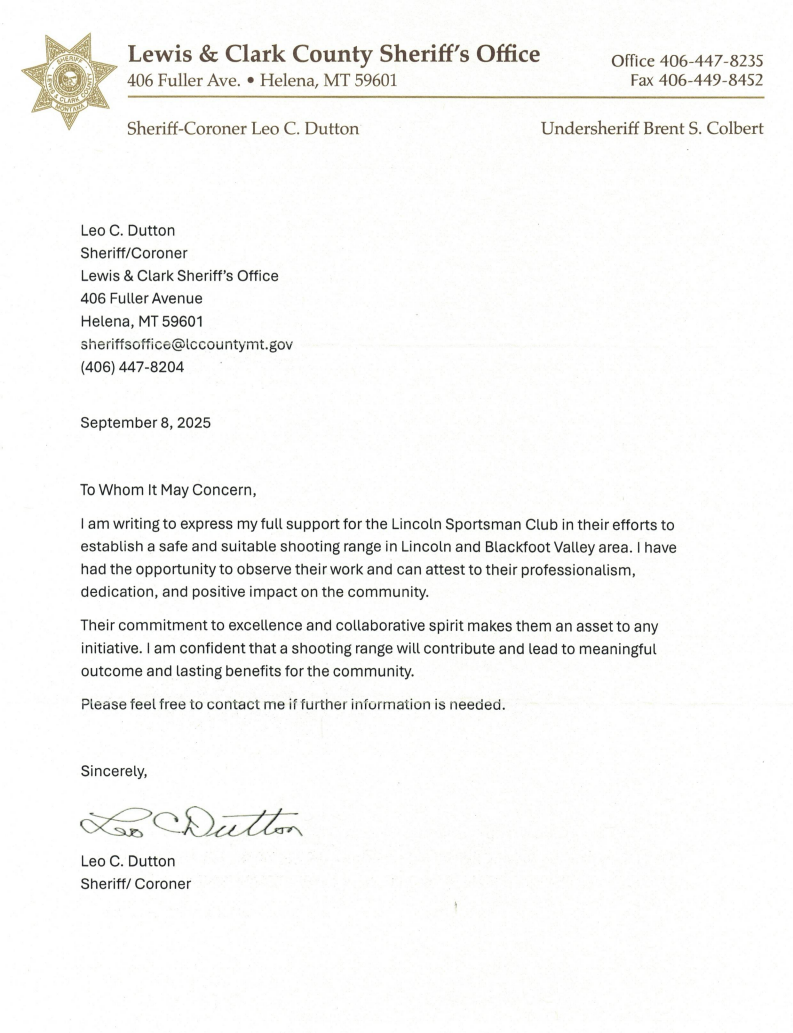
Lewis and Clark County Sheriff (See Exhibit E).
We support the Lincoln
Sportsmen’s Club’s Land Board Proposal to obtain a section of
state land near Lincoln for a community shooting range:
Senator Matt Regier
Senator Barry Usher
Senator Mark Noland
Senator Carl Glimm
Senator Mike Yakawich
Senator Greg Hertz
Senator Gayle Lammers
Senator Becky Beard
Senator Bob Phalen
Senator Daniel Zolnikov
Senator Denley Loge
Senator Theresa Manzella
The
following 125 people of Lincoln, MT and Upper Blackfoot Valley area
signed the Montana Shooting Sports Association Letter (petition)
dated July 29, 2025, indicating their support to petition the Land
Board for permanent use of a section of State land for the Lincoln
Sportsmen’s Club to establish a safe and suitable place for area
people to shoot:
Zach
Muse, Fire Chief LRFD
Gavin
Roselles, Powell County Sheriff
Brian
Patzer, President Lincoln Sportsmen's Club (LSC)
Marshall
Visger, Pastor Lincoln Baptist Church
Wendell
Weaver, Vice President LSC (2025)
Ernie
Lundberg, Area Chair Ducks Unlimited
Bruce
West, Board Member LSC (2025)
Brian
T. Jennings, Secretary LSC
William
L. Yaeger, Treasurer LSC
Dennis
Hefti, Range Master LSC
Scott
Skerlock, Vice President LSC (2026)
Ron
Shortridge, Board Member LSC (2026)
Tim
Sowa
Mark
Sowa
Donna
Copenhaver
Debbie
Patzer
Richard
Cosner, NLG Arms
Sheryl
Peterson
Kevin
Forkan
David
Brandow
Denise
Vandermark-Brandow
Steven
Copenhaver
John
Felciano
Gary
Smith
Patrick
Bickel
Aaron
Massey
Scott
McCaughtry
Cynthia
Sowa
Kinley
Cooley
Trenton
Grantier
Quinton
Grantier
Teresa
Castagne
Kelly
Hagan
Taylor
Jennings
Jennifer
Jennings
James
Reynolds
Lisa
Reynolds
Olivia
Dietz
Tahne
Jo Raynor
Shane
Raynor
Todd
Copenhaver
John
Manley
John
T. Manley
Andrew
Gomez
Thomas
Applegate
Chris
Caldwell
Jeff
Jorgensen
Cole
Orth
Cory
Garneau
Robert
T. Browne
Bill
Baker
Cody
Baker
Cody
Dailey
Becky
Dailey
Scott
Zarske
Julie
Zarske
Ashley
Eddington
Fred
Valiton
Tony
Tams
Denise
Browne
Grant
Slaght
Mary
Delaney Slaght
Dave
McKee
Bille
Jo Baker
Andrew
Patterson
Carver
Thompson
Kynslee
Thompson
Emily
Patterson
Alyssa
Daniels
Ty
Daniels
Bri
Cunha
Daniel
Schatz
David
Van Dyke
Keven
Patzer
Wyatt
Jorgensen
Trey
Phillips
Joshua
Spatig
Fran
Heath
Amanda
Hallsted
Tim
Welker
Forrest
Rogers
Linda
Shadel
Norine
L. Joyce
Walt
Joyce
Jon
Lamson
Melaya
Joyce
Logan
Joyce
Chad
Sutej
Clarence
Stine
Billy
J. Bratcher
Lynda
Mosher
Donna
Forkan
Chris
Joyce
Kelley
Patzer
Mary
Patzer
Judy
Hefti
Brenda
Henwood
Gerry
B. Malek
Michael
T. Hagen
Kasey
Reisbeck
Tabatha
Reisbeck
Nancy
L. Duel
Dave
Duel
Stephanie
G. Weaver
Emmett
L. Weaver
Don
LaRoque
Tamara
Jordan
Norma
Hughes
Irene
E. Weaver
Katherine
A. Schweiterman
Mike
Schweiterman
Frank
J. Malek
Renee
Lundberg
Sandra
Nobi
Laszlo
Nobi
Louie
W. Bouma
Mishayla
Fallis
Bridger
Reisbeck
Alex
Haas
Kathy
Tams
Cindy
Bettinelli
Jid
Bettinelli
Michelle
Mattick
Tim
Mattick
Melissa
L. Youderian
VI.
Lincoln Sportsmen’s Club’s Commitment
The
LSC is willing to agree to the following terms as a part of this
proposal, if control of the parcel in question can be transferred to
the LSC.
Hunter
education.
LSC agrees to allow the shooting range to be established on the
parcel to be used for training by FWP Hunter Education instructors
and the FWP Hunter Education Program, as needed, forever.
State
to retain timber rights.
The LSC is willing to accept that the State retain timber rights to
the land in question, thereby minimizing any loss to the state
school trust fund (understanding that the LSC will need to clear
some portions of the land for ranges, parking and other facilities,
but that such clearing will be kept to a minimum).
Fire
hazard reduction.
The LSC will actively engage in a fire hazard reduction program on
the land in question.
Weed
management.
The LSC will actively pursue weed management on the parcel in
question.
Accept
covenants.
The LSC will accept covenants with the land specifying that the
land may only be used for the purpose of a shooting range, together
with the necessary adjuncts thereto.
Survey
and transfer costs.
The LSC will pay the costs associated with transferring the
property, including the cost of a survey of the property.
Operate
and maintain range.
The LSC will operate and maintain the shooting range in perpetuity,
paying all costs of operation, liability insurance and improvements,
and allowing any member of the general public to become a member of
the LSC if the applicant is eligible to purchase a Montana hunting
license, and pays dues that are a reasonable share of the cost of
LSC business.
VII. Alternatives
The
Montana Shooting Sports Association strongly advises that local
firearms owners attempting to establish a shooting range, or to
manage or develop a range, must
own the land for the range. Without ownership, or secure, long term
control, members and volunteers simply will lack the motivation to
contribute the money and long hours needed to develop and maintain a
decent and safe range. LSC has recently been ousted from an
unsecured range location with no notice, a location in which it had
invested hundreds of man and equipment hours.
Also, shooting ranges must
have a considerable footprint, not only for the developed portion of
the range, but for a safety fan around the shooting areas.
Shooting ranges are not
profit-making operations. They are break-even propositions because
range operators plow all available income back into development.
This is also why a local club cannot afford to pay competitive lease
rates for shooting range property. Thus, the cost of adequate land
for a range is a major barrier to shooting range establishment.
This is why the enacted policy of the State of Montana to encourage
safe and suitable places to shoot is so vital.
Alternative 1.
(Preferred alternative). The State deeds Section 16 to the LSC,
with conditions that the parcel may only be used for a shooting
range and that the parcel reverts to the State if it should fall
into dis-management or if the LSC should become inactive.
Alternative 2.
The State deeds Section 16 to Lewis and Clark County with the
understanding that the County hand either deed or secured indefinite
use to LSC for a shooting range.
Alternative 3.
The state grants an easement to LSC for the perpetual use of
Section 16 as a shooting range.
Alternative 4.
The State enters into contract with LSC to allow LSC to use Section
16 for a shooting range for $1 per year for a minimum of 50 years.
VIII. Impact Analysis
A.
Financial Impact Analysis
Estimated grazing revenue for
Section 16 (low-productivity rangeland):
640 acres × 0.043 AUM/acre ≈
27.5 AUM annually.
27.5 AUM × $25/AUM ≈ $687
annual grazing lease value (approximate).
This represents the
approximate annual revenue potentially forgone if grazing is
displaced.
B.
No Net Loss Comparative Table (Estimated Annual Values)
Category
|
Estimated Annual Value
|
Notes
|
Grazing Lease Revenue
|
($687)
|
Approximate forgone
revenue
|
Fire Hazard Reduction
|
$200–$600
|
Fuel mitigation,
defensible space, volunteer labor value
|
Weed Control &
Monitoring
|
$100–$500
|
Ongoing treatment &
compliance
|
Active Site Stewardship &
Maintenance
|
$300–$700
|
Road maintenance, litter
removal, supervision
|
Net Estimated Impact
|
Neutral to Positive
|
Stewardship offsets
grazing revenue
|
C.
Legal Analysis
Where the trust corpus is
protected, timber rights retained, reversionary provisions included,
and long-term stewardship enhances land condition, the Board may
reasonably conclude that the arrangement secures legitimate and
reasonable advantage to the trust.
The relatively modest grazing
value, compared with active management and reduction of unmanaged
recreational impacts, supports a finding that the proposal does not
materially impair trust revenue and is in the public interest.
D.
Risk Mitigation Protections
- Retained timber rights.
- Recorded use covenants
limiting purpose.
- Reversion clause for
non-use or mismanagement.
- Liability insurance.
IX. Conclusion
For
the reasons stated above, the LSC requests that the Land Board make
the described real property available to the LSC for the purpose of
establishing a community shooting range in the Lincoln area. Such
action by the Land Board would serve the public interest in a
significant way. The
LSC requests that the State Land Board direct the Department of
Natural Resources and Conservation to execute documents consistent
with Land Board findings and the terms of this proposal.
Exhibit
A
From
the Montana Secretary of State website:
Lincoln
Sportsmen’s Club
Request
Information
Filing
Number
|
D248398
|
Entity
Type
|
Domestic
Non-Profit Corporation
|
Entity
SubType
|
Public
Benefit Corporation with members
|
Status
|
Active-Good
Standing
|
Formed
In
|
Montana
|
Principal
Address
|
2866
SPRUCE LANE LINCOLN, MT 59639
|
Mailing
Address
|
PO
BOX 114 LINCOLN, MT 59639
|
Registration
Date
|
05/01/2014
|
AR
Due Date
|
04/15/2027
|
Registered
Agent
|
Noncommercial
RA1600709 Brian Jennings 215 8TH AVE LINCOLN, MT 59639
|
Exhibit B
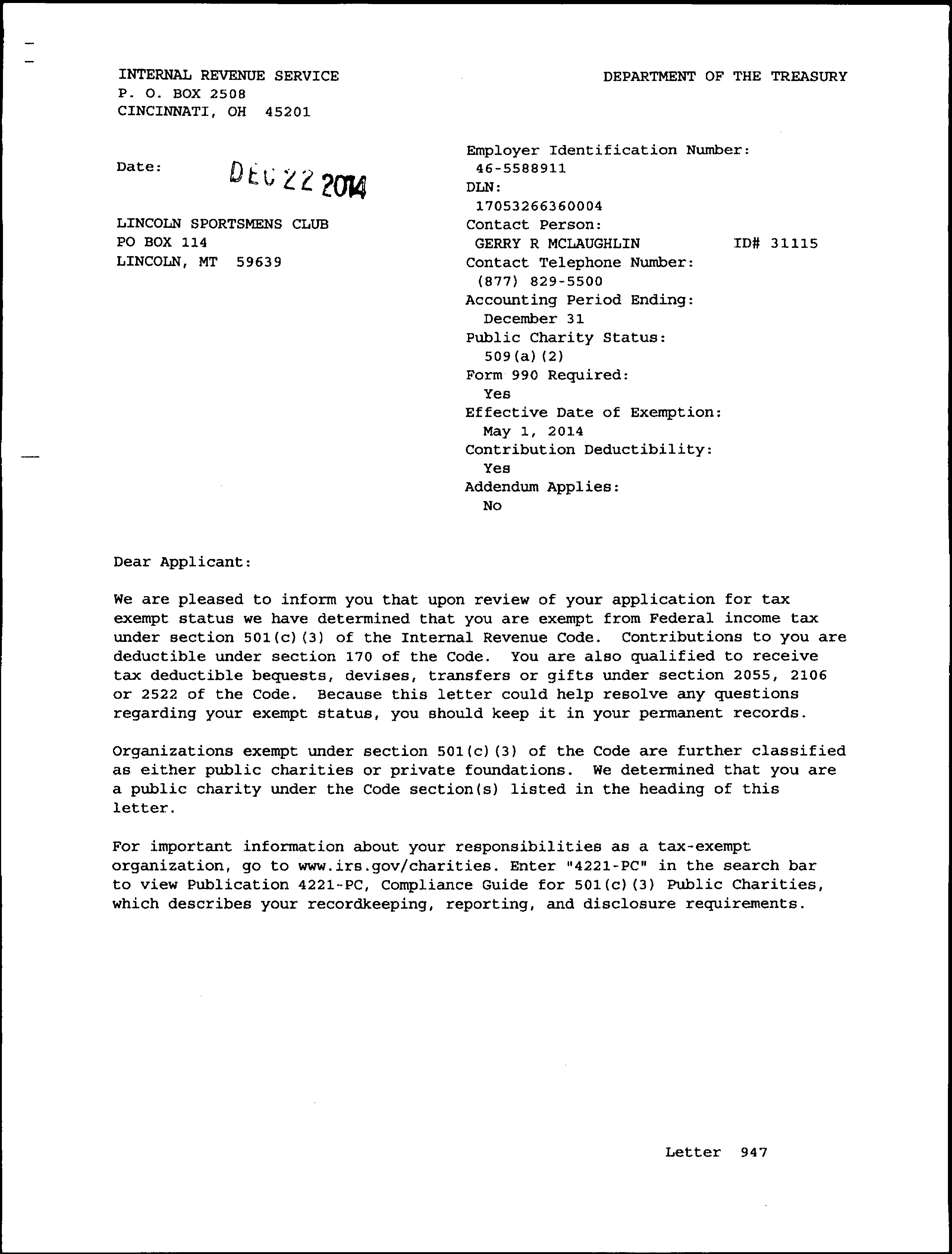
Exhibit C
Lincoln
Sportsmen’s Club
Proposed
Range Development
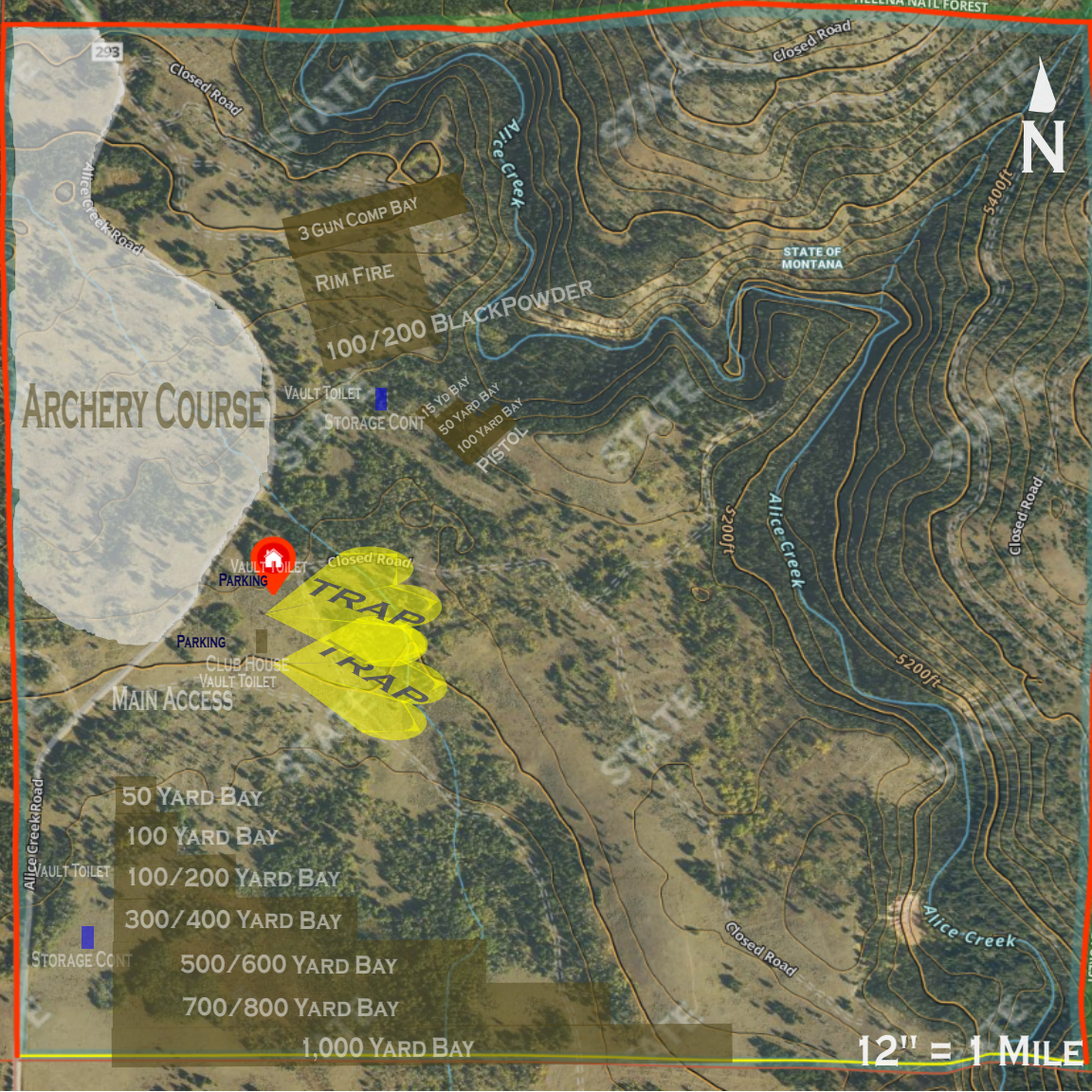
Exhibit D
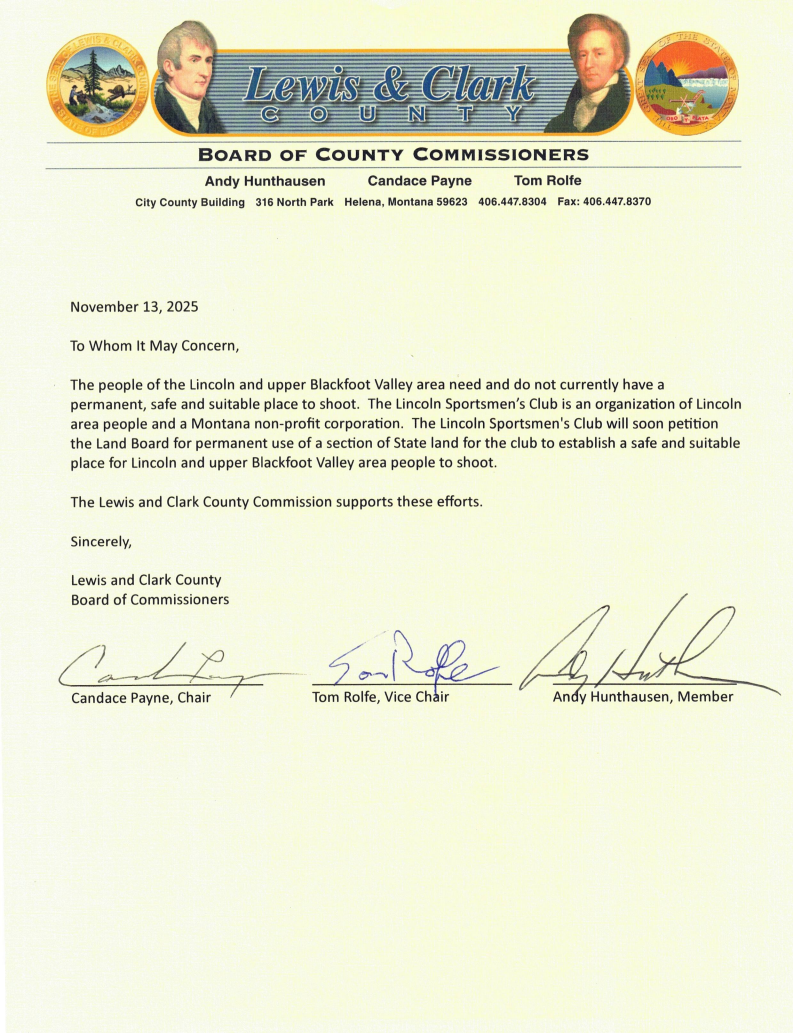
Exhibit E